Schedule a Free Consultation Today!
Schedule Now!There are different types of profit sharing plans and the one feature that separates them is the method in which the monies are allocated. Based on this, profit-sharing plans can be classified into two types
In traditional profit sharing plans, all participants receive an equal profit-sharing allocation.
Advantage
Mandatory IRS testing may not be required.
Disdvantage
The plan allocation cannot be skewed in favour of the owners or key employees. This is a major disadvantage if you are looking to put aside more money for yourself as the owner of the business.
Who favors this design
A business where every employee contributes the same amount of expertise in the running of the business would favour this design. For example, a small consulting firm operating in a niche segment with three employees would favour such a design.
Allocation in a traditional profit-sharing plan;
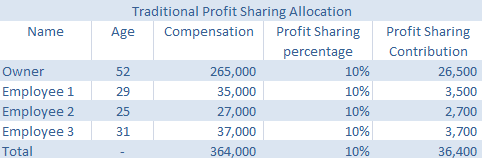
![]() | Allocation to Owner: $26,500 Allocation to Employees: $9,900 |
|---|
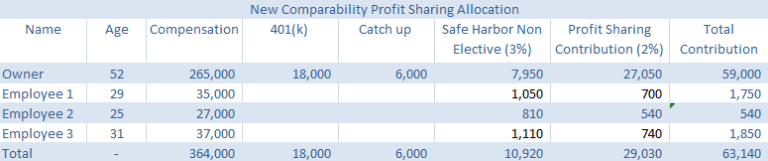
![]() |
Allocation to Owner: $54,000 Allocation to Employees: $4,950 |
|---|
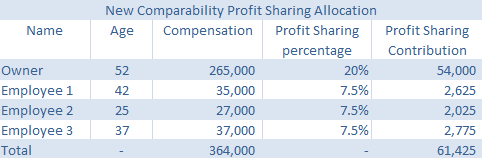
|
Allocation to Owner: $54,000 Allocation to Employees: $7,425 |
|---|

Note: Allocation amounts shown are illustrative examples. For 2026, the IRS maximum annual additions per participant is $72,000 (or $80,000 with the age 50+ catch-up, or $83,250 with the age 60–63 super catch-up). Maximum compensation taken into account is $360,000. Actual allocations depend on plan design, compensation levels, and IRS non-discrimination testing. Source: IRS Notice 2025-67.
Once you have decided to add the 401k feature, additional testing requirements come into play. This is because the IRS requires testing to be carried out for different money types and between different groups. For example, the deferrals by the owners have to be tested against the deferrals by the employees and similarly for the profit-sharing allocations.
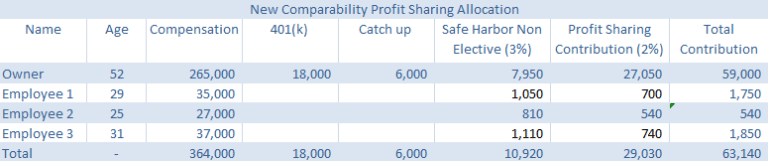
A frequent problem arises when the owners and the key employees defer to their 401k’s but the employees do not. This results in a failed test. In order to avoid this, the profit-sharing plan will have to evolve into a Safe Harbor Plan. This is achieved by segmenting the total profit-sharing allocation into a Safe Harbor Allocation (3% of W-2) and the rest will be deemed as a profit-sharing allocation. The Safe Harbor allocation is 100% vested immediately. This can be explained better with an example. Let’s take the case study above where the business owner wanted to contribute the maximum amount to his own retirement. Since this owner was above the age of 50, an additional $7,500 can be contributed as a catch-up. Below is how the allocations would change;